
Category Archives: Artificial Intelligence

Watch the Latest Update from the Neuralink Team

https://platform.twitter.com/widgets.js
  • Neuralink has successfully implanted brain-computer interfaces in 7 human participants (4 with spinal cord injuries, 3 with ALS)
  • Participants are using the devices an average of 50 hours per week, with some exceeding 100 hours weekly
  • The device enables control of computers, phones, and gaming systems purely through thought
  • First participant broke the BCI world record for cursor control on day one, surpassing decades of prior research

    Product Roadmap Near-term (2025-2028)
  •   2025: Speech decoding capability – directly converting thoughts to words
  •   2026: First “Blindsight” participant – restoring vision to blind individuals; tripling electrode count to 3,000
  •   2027: Multiple implants per person; increasing to 10,000 channels
  •   2028: 25,000+ channels per implant; treating psychiatric conditions and pain

    Most Impactful Applications
  1.   Digital Independence: Paralyzed users can work full-time jobs, communicate, and control devices independently
  2.   Robotic Control: Users can control robotic arms and hands, with plans to enable full control of Tesla Optimus robots
  3.   Vision Restoration: Blindsight will initially provide low-resolution vision, eventually surpassing human capabilities (infrared, ultraviolet, radar)
  4.   Body Reanimation: Future capability to bridge damaged neurons, potentially allowing paralyzed individuals to walk again
Driverless Cars Can Be Jerks Too

So when your driverless car cuts someone off, will the road rage be directed at you… the passenger?

 Today’s top story, from reporter Anabelle Nicoud, IBM Think Newsletter

If you’ve ridden in a Waymo recently and found your driverless taxi to be more assertive and, dare we say, more human on the road, you’re not imagining things. The Alphabet-owned company, which has been navigating passengers in San Francisco, Austin, Phoenix and LA, is now exhibiting very human-like traits, according to the San Francisco Chronicle. No drunk driving or road rage, of course, but under the right circumstances, that white Jaguar might indulge in a honk or two. As it turns out, a more commanding Waymo yielded safer rides, the Chronicle reported. “Being an assertive driver means that you’re more predictable, that you blend into the environment, that you do things that you expect other humans on the road to do,” David Margines, Waymo’s Director of Product Management, said in an interview with the paper. “It’s a very interesting kind of paradox here: we need less perfection to really fit social norms,” said Kaoutar El Maghraoui, a Principal Research Scientist at IBM, in this week’s Mixture of Experts. According to the company’s data, Waymo is safer than human drivers. And yet, part of being so might just be by mimicking our bad, albeit predictable, habits, favoring social compatibility over algorithmic perfection. Uncanny valley, you say? Technically, Waymos could be enjoying more free-form decision-making, thinks Gabe Goodhart, Chief Architect of AI Open Innovation at IBM. He likened older, rule-based vehicles to the chatbots of yore—pre-generative AI systems beholden to clunky decision trees. But as autonomous vehicles adopt more human-like behavior—and choice—drivers may feel more comfortable because the cars better adhere to their expectations. “If we start applying this more flexible way of adapting [the car’s] behavior to the environment … it may make the vehicle fit in a whole lot better,” he said on the podcast. As more driverless cars hit the streets of American cities—from Zoox to Tesla’s newly launched robotaxis—it will be fascinating to watch how they adapt to robot driving. Could it pave the way to more collaboration between tech giants? “A lot of open-source consortiums have started because of similar problems,” noted Ann Funai, CIO and VP of Business Platform Transformation at IBM. “There’s this area where you need common understanding, common knowledge, common engagement. Maybe that means agreeing to use the same open-source component for training, so we’re not all crashing into each other.” Listen to the full episode on YouTubeSpotify and Apple Podcasts.

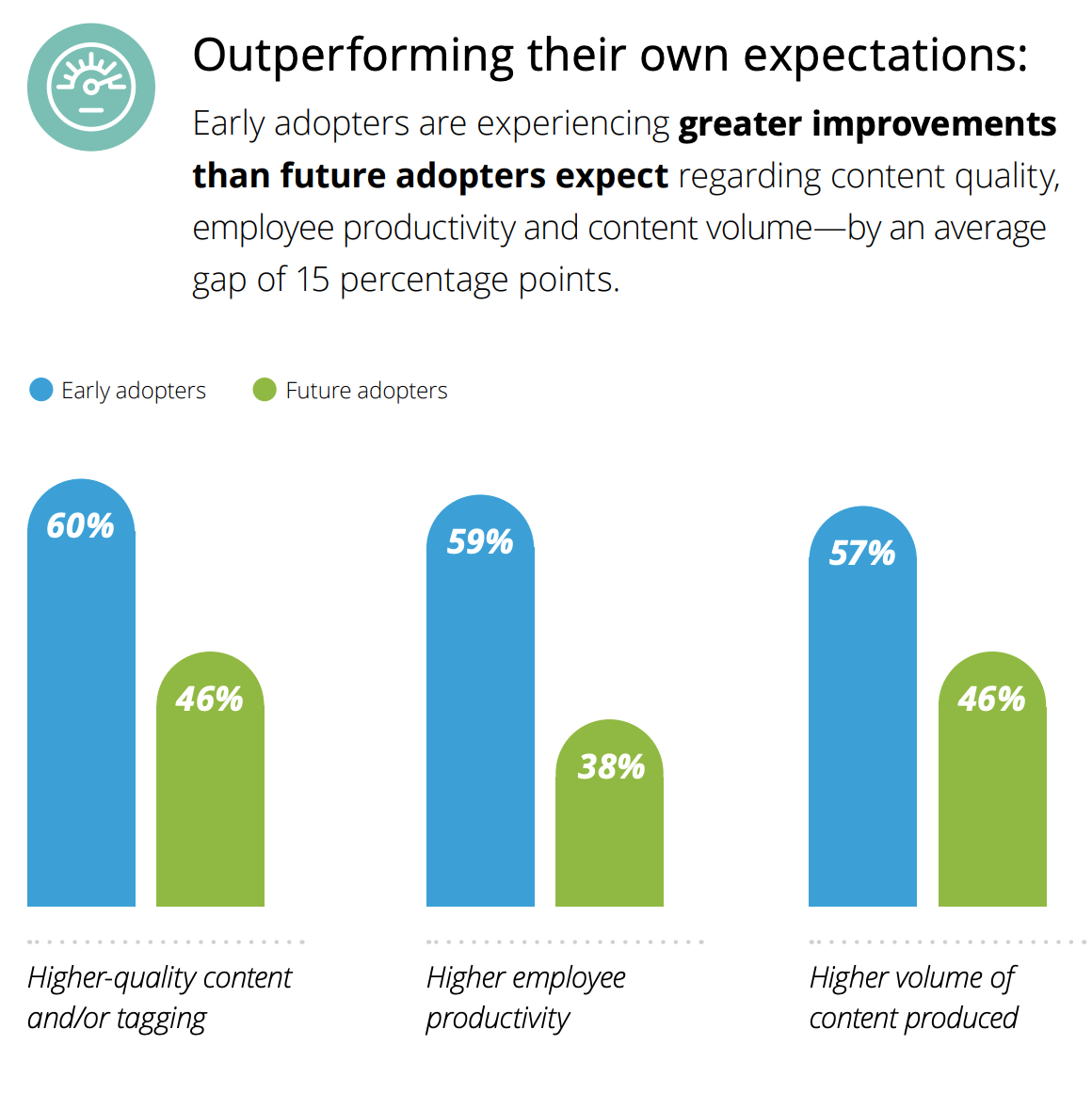
Gen AI Powers Content Marketing Advantage for Early Adopters

Deloitte Digital’s new research on Generative Artificial Intelligence (Gen AI) in marketing content production reveals that Gen AI is already reshaping content production giving brands an advantage.

See the research that should compel you to collaborate with a forward leaning Gen AI content marketer.

See More [R. Michael Brown Marketing & Communications Consulting]

She’s Not Real…. But ‘It’ Has Plenty of Followers

Her fans think they found true love — but she’s not real. 

Milla Sofia is an artificial intelligence-generated influencer whose sultry photos on Twitter and TikTok are racking up thousands of likes from deluded social media users, Futurism reported.

“[I’m a] 19-year-old virtual girl from Helsinki Finland. I was made by AI. Check my other social media accounts from the link below,” reads the Twitter bio on Sofia’s account. 

Sofia, who goes by @AiModelMilla on her verified Twitter account, is certifiably fake, yet her 7,790 followers can’t help but drool over bikini photos of her in Greece.

“Still in Santorini, and I’m ‘Greek’-ing out over how to leave this paradise!” reads a punny tweet from July 19 with over 35,000 views and 2,000 likes.

‘Wow, look at you, so stunningly beautiful with a gorgeous smile,” writes one Twitter user.

Is digital beauty also only skin deep?

Do most of her followers know? What do you think?

See More [NY Post]

AI for Marketing Software Platforms

Future Success Today: Become an AI Authority and Supercharge Your Marketing

I’m a marketing pro on a mission to become an authority on Artificial Intelligence (AI) so I can use the tech to help clients with faster and improved marketing and business – with better results.

I’m looking forward to us doing this together. Nobody can do it alone. Here’s what I’ve found up to this point.

From predictive analytics and machine learning algorithms to natural language processing and chatbots, and visual creation systems, I’ve been searching to understand how these innovations can enhance customer experiences and drive results.

How I’m Using this New AI Knowledge

As I learn these complex AI concepts and skills, I’m working on crafting them into simple, actionable insights and projects for my clients.

Most importantly, I’m trying it out. Learning by doing is the only way with new tech.

I’m experimenting with AI-driven software for marketing content and campaigns, including:

  • An AI video generator called Synthesia. Still a bit robot-like but amazing that it can do it.
  • Learning prompting on ChatGPT (OpenAI) and Bard (Google) to generate more ideas.
  • Creating realistic images and art from a description in natural language with DALL-E.
  • Using SoundDraw to generate custom music for use in video.
  • Multiplying video content with Vidyo.
  • Doing creative headline and keyword research to maximize SEO with VidIQ.

See More [R. Michael Brown Marketing News]